The problem
Second-hand clothing is widely assumed to be the most sustainable choice. But that assumption ignores how people travel to buy it, what they do with the money they save, and whether the purchase actually replaces something they would have bought new. When those factors are left out, interventions that look good on paper can fail to reduce environmental impact, or quietly make it worse.
The research
Seven sustainability-minded consumers participated in a cultural probe study designed to capture clothing behaviour honestly over time. LCA and EVR calculations were run across 36 scenarios, covering a cotton t-shirt and jeans across fast fashion, sustainable brand, and second-hand options, with multiple transport modes factored in.
Key findings
- No single consumption pattern among sustainability-minded individuals, with significant variation across participants
- For jeans: second-hand was environmentally preferable regardless of transport mode
- For t-shirts: transport was significant enough to flip the ranking — cycling to buy from a sustainable brand could be better than driving to a second-hand store
- Savings from second-hand are often spent on food, housing, or more second-hand rather than reducing overall consumption
With seven participants, the findings point to patterns rather than population-level conclusions. So the next step was turning the research into something a product or strategy team could actually use.
The design
Two design outputs came out of the research: a set of consumer archetypes and a strategic decision framework.
Consumer archetypes
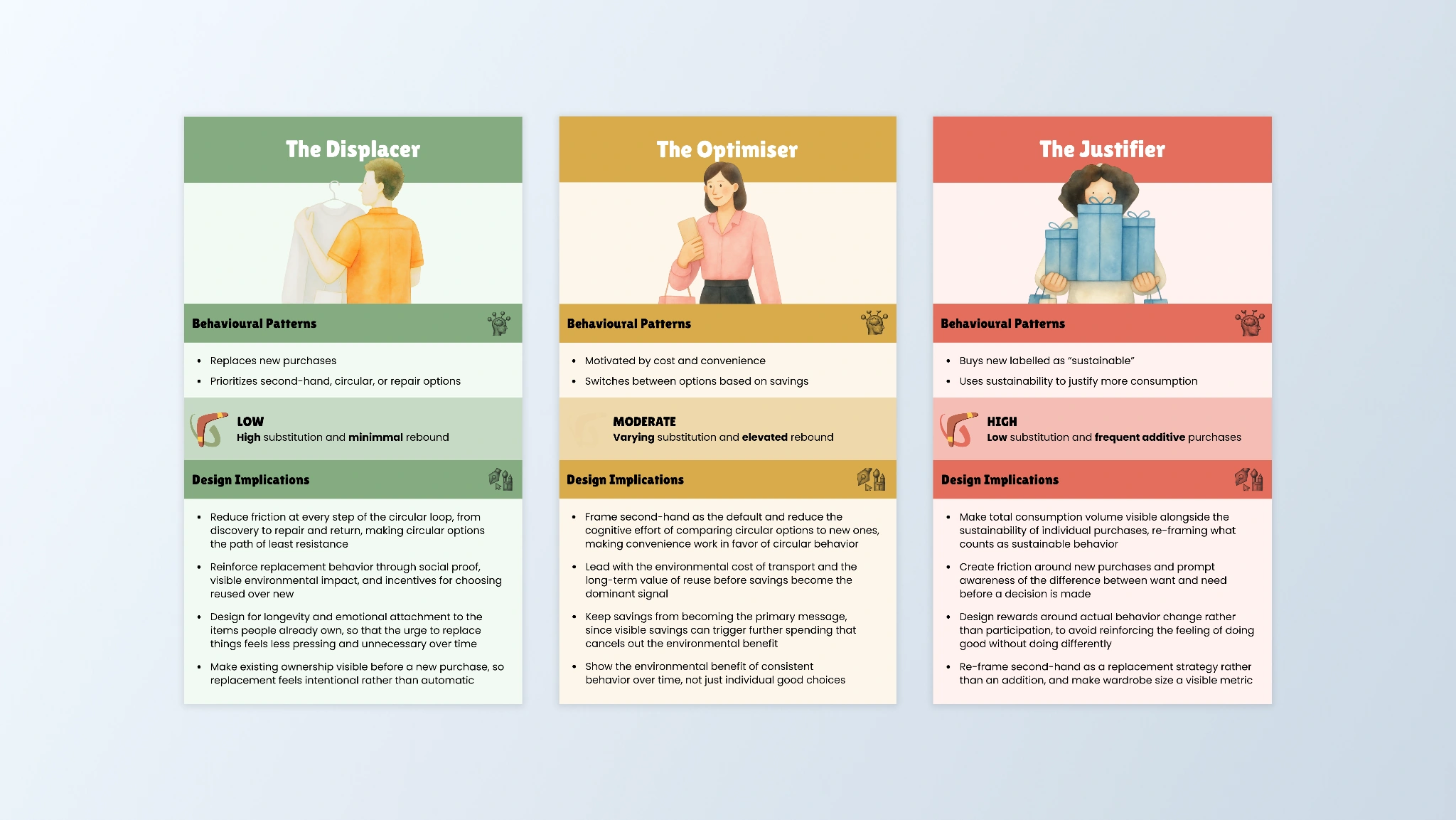
Three archetypes based on consumption patterns observed in the study, each with specific design implications. The Displacer consistently replaces new purchases with second-hand and needs friction reduced in switching to reused options. The Optimiser is motivated by cost and convenience and switches between options based on savings, so the challenge is keeping value inside the circular loop and highlighting sustainability benefits before savings become the main signal. The Justifier uses second-hand to justify buying more overall, so the design response shifts to removing the moral licence to consume rather than making second-hand more appealing.
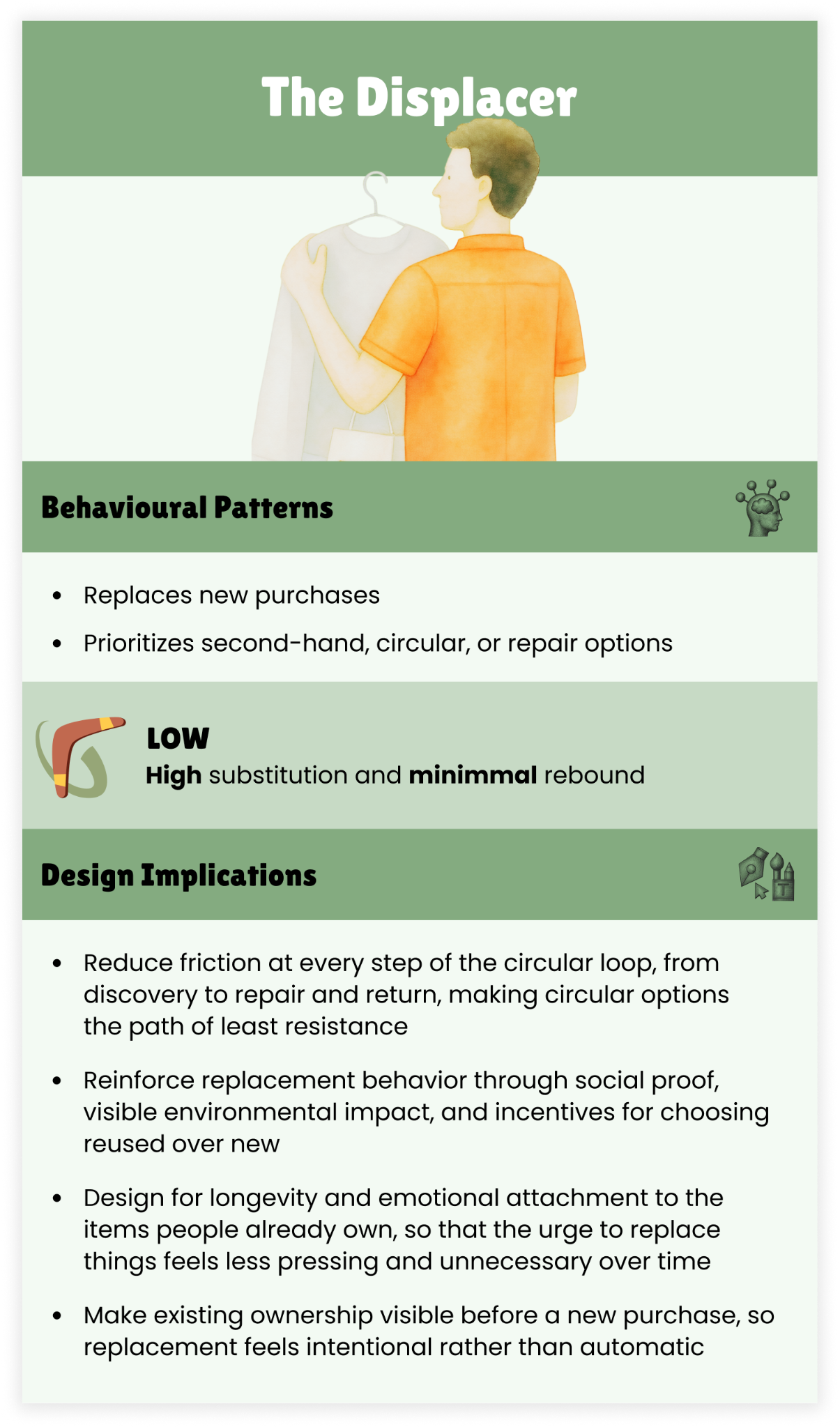
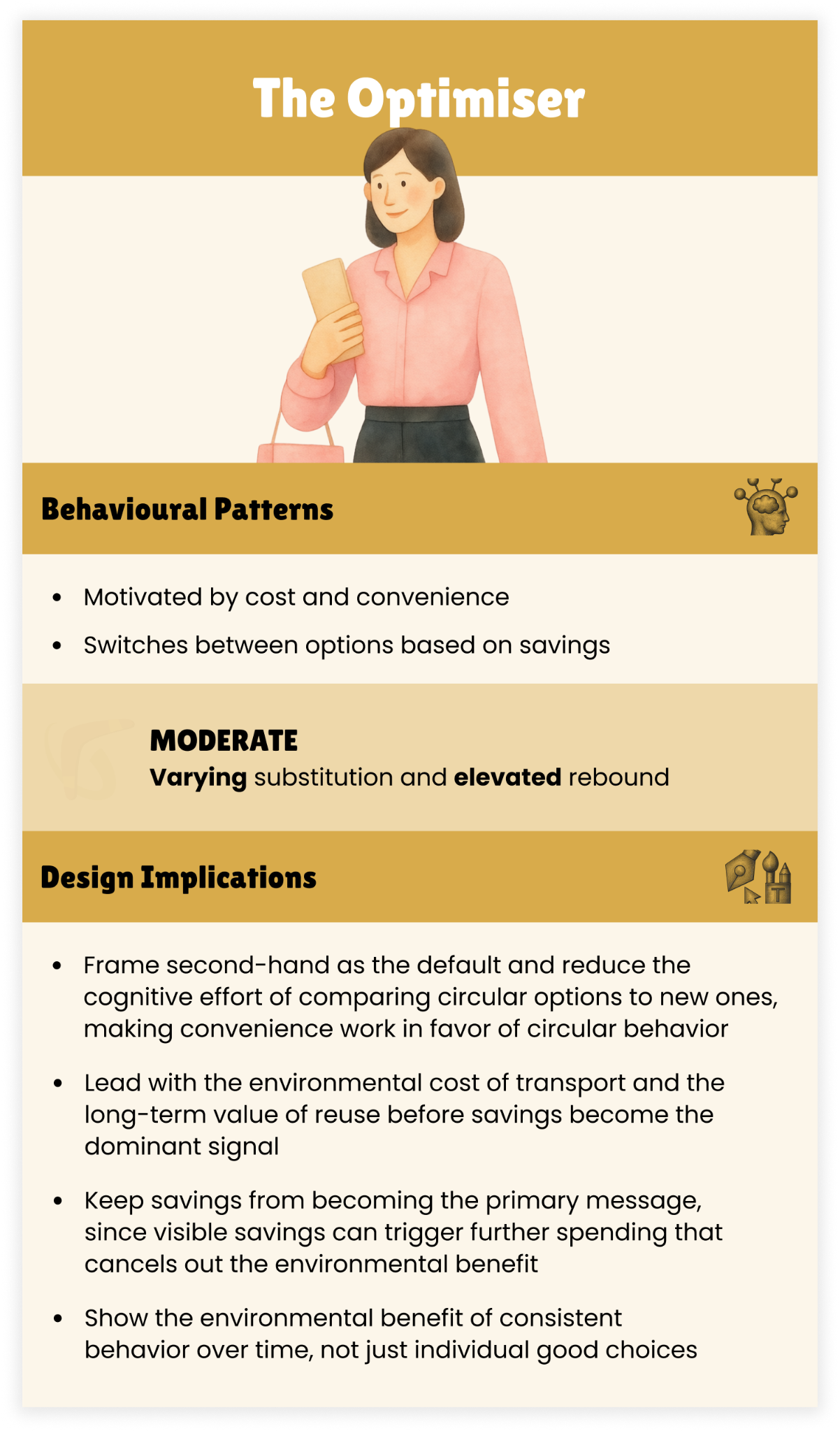
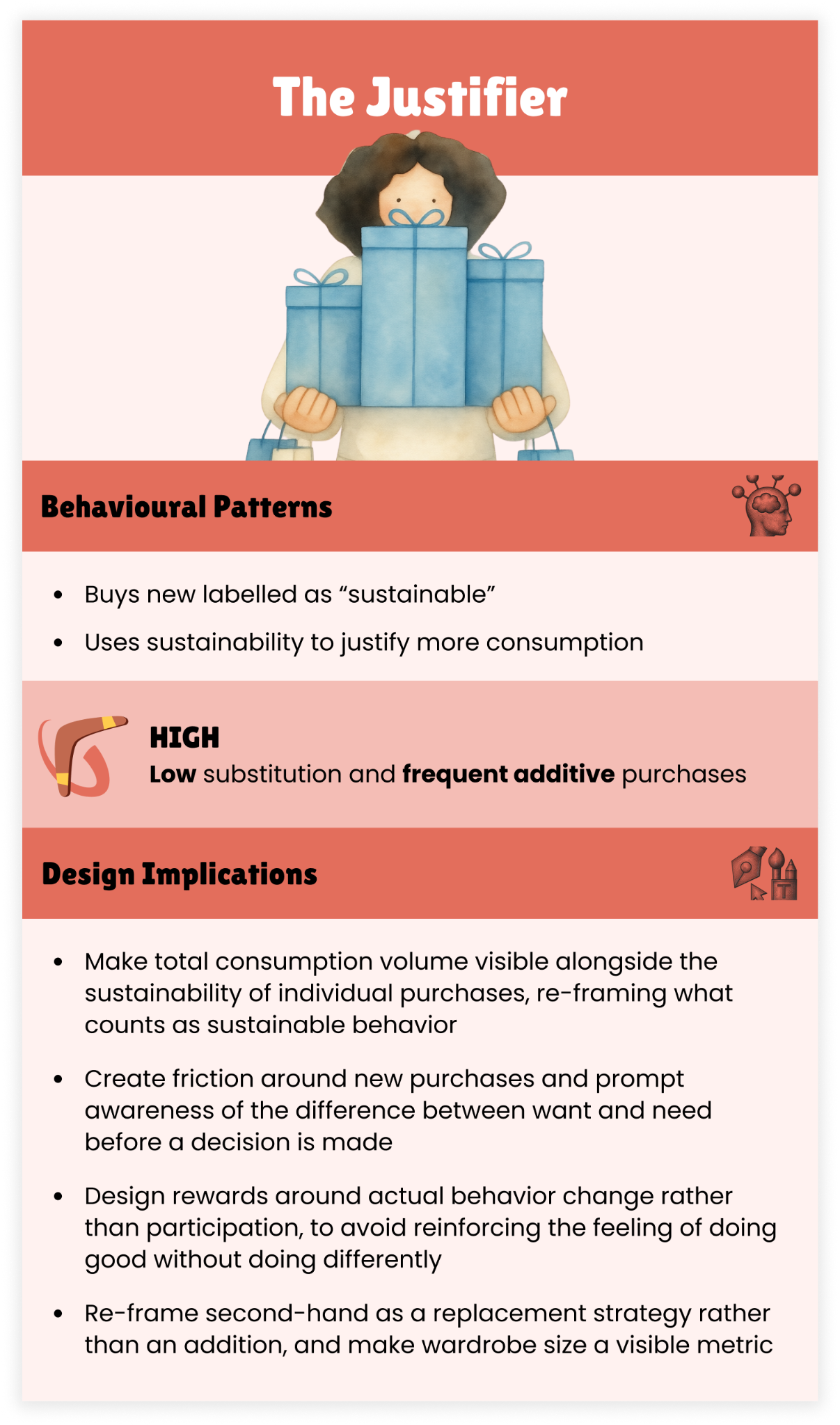
The three consumer archetypes with behavioural patterns and design implications for each
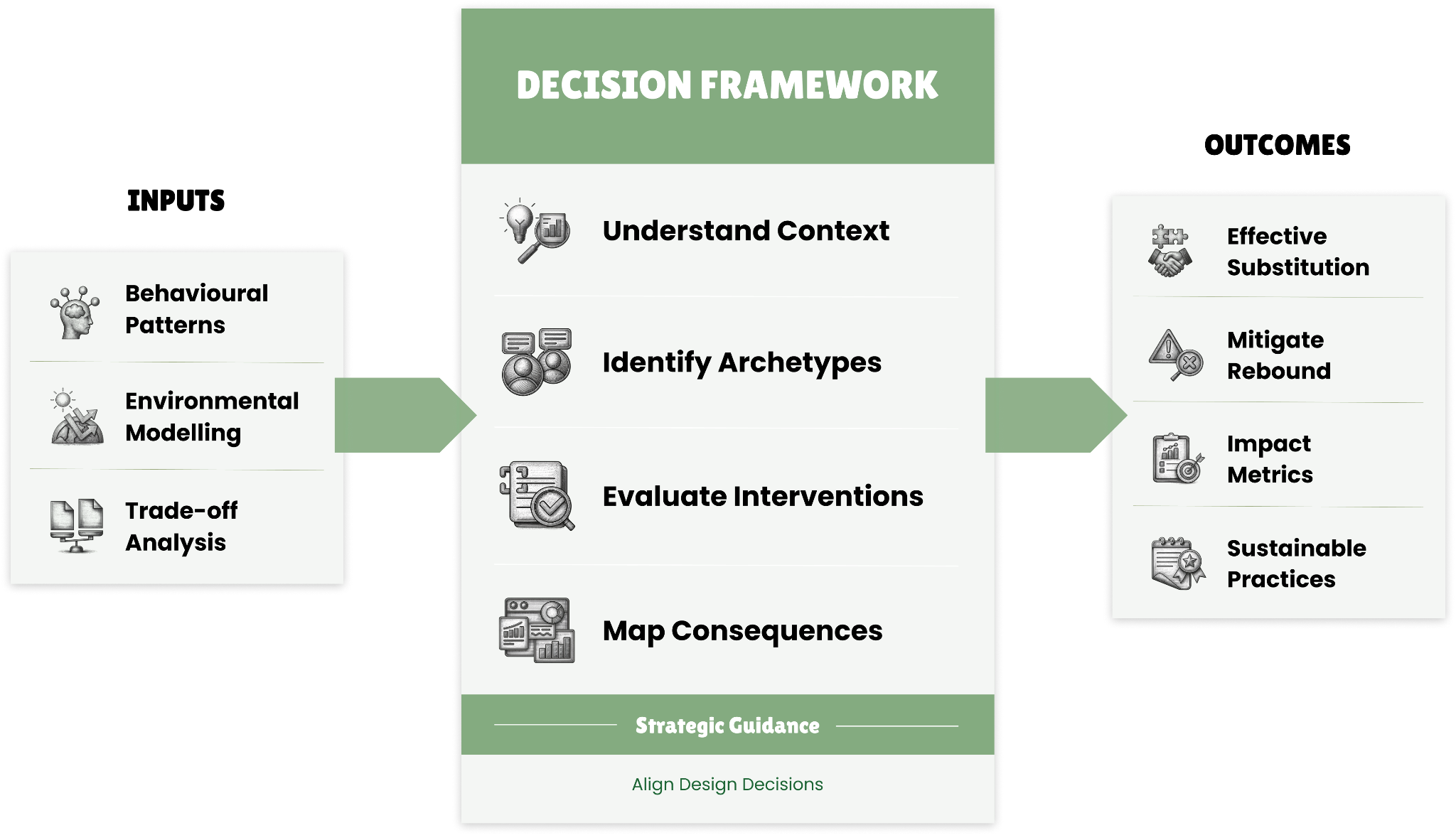
The strategic decision framework: inputs, four-step process, and intended outcomes
Strategic decision framework
A four-step decision process for product and strategy teams: understand the consumption context, identify which archetype is being designed for, evaluate which interventions are likely to work, and map the consequences. Takes behavioural patterns, environmental modelling, and trade-off analysis as inputs, and aims at effective substitution, rebound mitigation, and sustainable practices as outcomes.
The decisions
EVR over standalone LCA eco-costs
Eco-costs alone don't account for what consumers actually pay, so transport costs are invisible in the calculation. The Eco-costs/Value Ratio factors in what people spend, making rebound effects visible in the numbers rather than treated as a separate consideration.
Cultural probes and follow-up interviews over standard interviews
Standard interviews risk socially desirable answers, especially on a sensitive topic like sustainability behaviour where participants may want to protect their self-image. Cultural probes let participants reflect on questions in their own time without the researcher present, so the data is less likely to reflect how people want to be seen and more likely to reflect what they actually do. Follow-up interviews were then used to go deeper on the probe responses.
The point
What I kept coming back to in this project was how much the sustainability narrative around second-hand relies on ignoring inconvenient variables. The archetypes and framework are only useful because they don't, and I think that's the more general point. It's easier to design around a simplified version of a problem, but the design only works if it accounts for how people actually behave, not how you'd prefer them to.